Here is what plenty of us already understand, even if we often keep it to ourselves: Latinidad is anti-Black. It has been from the start. And those of us who are Black Latinx need to stop treating it like it can hold us. History is not subtle about this. According to Dr. Michel Gobat, the idea of a shared “Latin” identity in the Americas takes shape in the middle of the nineteenth century, tied to French imperial aims under Napoleon III, meant to push back against Anglo-Saxon expansion (Gobat, The American Historical Review, Vol. 118, No. 5, 2013). Before that, Michel Chevalier had already sketched the logic, claiming peoples of “Latin” origin would naturally cohere as a racial bloc aligned with France, and beneath it (John Leddy Phelan, “Pan-Latinism, French Intervention in Mexico (1861–1867) and the Genesis of the Idea of Latin America,” in Conciencia y authenticated historical, UNAM, 1968). White Creole elites in South America and the Caribbean grabbed this framework and ran with it. It offered them a ready-made postcolonial story where European ancestry sat comfortably at the top, and Black and Indigenous people were kept in their place below. Decades later, in the United States, Latinidad got refashioned into a tool for coalition politics. By the 1970s, Mexican Americans, Puerto Ricans, and others used it in real fights for civil rights and representation. I do not dismiss that work; those organizers-built power under conditions that were real. Still, once Felix Padilla put the concept into theory in Latino Ethnic Consciousness (University of Notre Dame Press, 1985), describing it as a situational identity shaped by shared structural inequality, and once the 1980 Census locked “Hispanic/Latino” into place as an official category, a different effect took over: a single label that made Black and Indigenous people harder to see inside the populations it claimed to describe. Out of that comes the same familiar product: a mestizo ideal, a story about “La Gran Familia” mixture that flatters and rewards proximity to whiteness.
Turn on any major Latino media outlet, scan any telenovela casting, walk into any meeting held under the banner of “Latino unity,” and usually, proximity to whiteness dominates, as well the politics of Black liberation is silenced. Black Latinx people are missing, reduced to a symbol, or pressured into believing that bringing up race is disloyalty to a community that was structured to keep them at the margins. Adding “Afro” or “Black” in front of latinidad does not fix the foundation; it reinforces it. That move asks Black people to swallow the whiteness built into latinidad and call it belonging. A prefix cannot erase centuries of anti-Blackness; it just makes the arrangement feel more acceptable.
Scholars like José Esteban Muñoz describe latinidad as “messy” and “unstable,” and this is why the five-week seminar I teach is called the Black Puerto Rican Radical Tradition. Latinidad is not our baseline for any discussions on race; we deconstruct it and move on from the concept that was made to lump people together more than it was meant to free them, and how that lack of ideological substance is not a mistake, it is the point. A word with no political spine cannot carry a political project. What it can do, and what Latinidad has done, is pull Black and Indigenous people into a category that dulls their specific histories of struggle, swapping political sharpness for demographic readability. In organizing and social justice spaces, language is not decoration. When we speak with terms that blur us out, we drain the politics from our own Blackness. We show up to the table having already handed over the framework we need to name what has been done to us and to demand an accounting. This continuing erasure is why I created the Black Puerto Rican Radical Tradition. In this five-week seminar, we explore the historical, cultural, and political forces shaping Black-Puerto Rican resistance movements across the diaspora. Rooted in Pan-Africanism, Puerto Rican nationalism, hip-hop culture, and cultural production, this journey provides essential tools. In this space is where we deconstruct latinidad and center pro-Blackness.
In 2019, the Nation published an article: The Problem with Latinidad by Miguel Salazar. This is what I said: “Latinidad’ is an academic term that failed because it erases away race. For those of us who are Black Puerto Ricans or maybe identify as Indigenous, what it really does is it just waters down who we are, and it erases Blackness. Clemente argues that Afro-Latino identity has often fed into rather than disrupted the myth of a multicultural democracy in Latin America—the idea that people are a “perfect blend” of African, Spanish, and Indigenous heritage. This framing becomes a way to deny institutional and individual Her personal stance. Clemente identifies as a “Black Puerto Rican” rather than Afro-Latina, explaining that “Afro is not a race and neither is Latino, Latina or Latinx. Those are not races, they’re not ethnicities.” She sees terms like Afro-Latino as focusing too much on culture—”food, dance and skin color”—without a real political commitment to Black liberation.“
Some scholars still argue Latinidad can be reclaimed and turned into a decolonial project. I refuse that, fully. You cannot reclaim what was never built with you in mind. Audre Lorde said it plainly: “The master’s tools will never dismantle the master’s house.” I know exactly who I am, a Black Puerto Rican woman whose ancestors arrived at the Western hemisphere in chains. That is not a subcategory inside someone else’s framework. Our Blackness is complete, and it does not need to negotiate for space inside a concept constructed to make us disappear. So come on the journey to decolonize your mind and learn how to uproot anti-Blackness in yourself, your family, your job, your community.
The third cycle of the five week seminar, the Black Puerto Rican Radical Tradition begins May 3rd adn ends May 31st, 2026. To sign-up email me at clementerosa@gmail.com, the fee is $150 and payment arrangements are available.
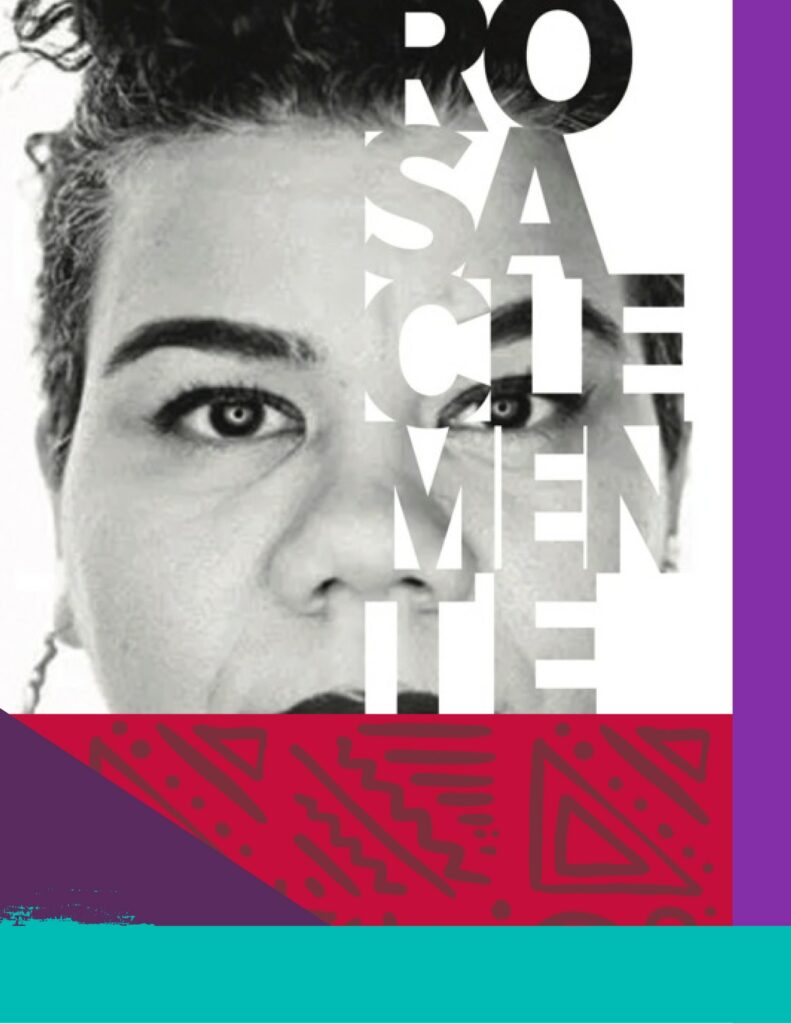
Rosa Alicia Clemente is an award-winning organizer, speaker, political commentator, producer, independent journalist, scholar-activist and former vice presidential candidate. In 2008, Clemente made her story when she became the first Afro-Latina to run for vice president of the United States on the Green Party ticket. Since then, Clemente has continued to be a powerhouse. She is the creator of Know Thy Self Productions, under which she has organized multiple national tours; PR on the Map, an independent, unapologetic, Afro-Latinx-centered media collective founded in the aftermath of Hurricane Maria; and the Black Diasporic Organizing Project, a nonprofit dedicated to combating anti-Blackness within the wider Latinx community. Recently, she was also associate producer on the 2021 Oscar-winning biographical drama film Judas and the Black Messiah. She is currently completing her PhD at the W.E.B. DuBois Center at the University of Massachusetts Amherst.